How To Meet Fume Hood Face Velocity Requirements
Quick Summary
OSHA's Laboratory Standard requires fume hoods to function properly, but it does not set a single face velocity for every hood; its non-mandatory appendix cites typical face velocities of about 60 to 100 feet per minute (fpm). Conventional hoods commonly operate near 100 fpm, while high-performance hoods are engineered to contain fumes at about 60 to 80 fpm. Meeting fume hood face velocity requirements depends on accurate measurement, controlled room airflow and testing at least annually.
Understanding and Achieving Proper Fume Hood Face Velocity
A fume hood can look perfectly normal while quietly letting vapors escape into the room. Fume hood face velocity, the speed at which air moves through the open sash, is the first number that reveals whether one of a lab's fume hoods is protecting the people in front of it. Understanding OSHA fume hood face velocity requirements, and how industry test methods apply them, can help a lab keep every hood safe and compliant.
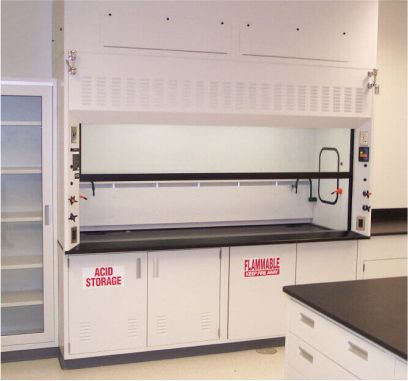
What Is Fume Hood Face Velocity?
Face velocity measures how fast room air enters the face of a fume hood. When it is too low, contaminants can drift out of the opening. When it is too high, the incoming air can create turbulence and eddies that pull vapors back toward the user. A correctly operating hood holds face velocity within a steady, moderate range.
OSHA Fume Hood Face Velocity Requirements and Industry Guidance
The OSHA Laboratory Standard (29 CFR 1910.1450) requires employers to make sure fume hoods and other protective equipment function properly. It does not set one mandatory face velocity for all hoods. Its non-mandatory Appendix A cites typical face velocities of about 60 to 100 linear feet per minute, and many facilities set internal targets in the 80 to 120 fpm range for conventional hoods. Performance itself is commonly verified with the ANSI/ASHRAE 110 test method, which looks at containment as well as airflow speed.
The Optimum Face Velocity for a Regular Fume Hood
For a regular, conventional chemical fume hood, a face velocity of about 100 fpm is the most common operating target. High-performance fume hoods are designed differently and can contain fumes safely at roughly 60 to 80 fpm, which may reduce exhaust volume and energy use.
How to Measure Fume Hood Face Velocity
Face velocity equals the exhaust airflow divided by the open sash area. A hood exhausting 1,000 cubic feet per minute through a 10-square-foot opening, for example, has an average face velocity of 100 fpm. In practice, technicians measure rather than calculate:
- Set the sash at its normal working height.
- Take anemometer readings at points across an even grid over the opening.
- Average the readings and note any points well above or below the average.
- Use smoke visualization to confirm air moves smoothly into the hood.
The ASHRAE 110 method adds a tracer gas containment test using sulfur hexafluoride, which confirms the hood is capturing contaminants rather than only moving air.
Factors That Affect Fume Hood Face Velocity
Sash height has the most immediate effect: raising the sash enlarges the opening and lowers face velocity unless the system compensates. Building airflow matters just as much. Supply diffusers, open doors and foot traffic can create cross-drafts at the hood face, and an imbalanced HVAC or exhaust system can cause readings to fluctuate.
Correcting Low or High Face Velocity
Low face velocity often traces to an exhaust fan problem, a blocked or closed damper, loose ductwork or a sash raised above its rated height. Checking the fan, clearing obstructions and resetting the sash stop can restore airflow. High face velocity may come from an oversized exhaust setting or a sash lowered further than intended, and rebalancing the system can bring it back into range while saving energy.
Fume Hood Inspection and Calibration
Fume hood inspection is an ongoing task. Hoods are typically tested at installation, at least annually afterward and whenever the room layout, ventilation system or hood itself changes. Airflow monitors should be checked for fume hood calibration during each visit. PSA Laboratory Furniture provides fume hood certification using the ANSI/ASHRAE 110-2016 method, factory-calibrated equipment and membership in the Controlled Environment Testing Association.
Request a quote for fume hood testing or new hoods that meet your lab's face velocity requirements. Get in touch with us to learn more today.
Frequently Asked Questions About Fume Hood Face Velocity
OSHA requires fume hoods to function properly as part of a lab's chemical hygiene plan. Documenting each hood's test results and corrective actions can show that the requirement is being met.